
The TCHC Planting and Stewardship Program brings together LEAF, TCHC and the City of Toronto to engage communities in the planting and stewardship of native trees on TCHC properties. Since 2018, 536 trees have been planted across 47 sitesas part of this collaborative effort.
Following planting, TCHC tenants provide ongoing care through regular watering and mulching to help the trees survive and grow into a lasting part of the urban canopy.
To support tenants’ stewardship efforts, LEAF provides specialized structural pruning through an annual TCHC pruning day. Pruning takes place in late fall, which is a great time to prune.
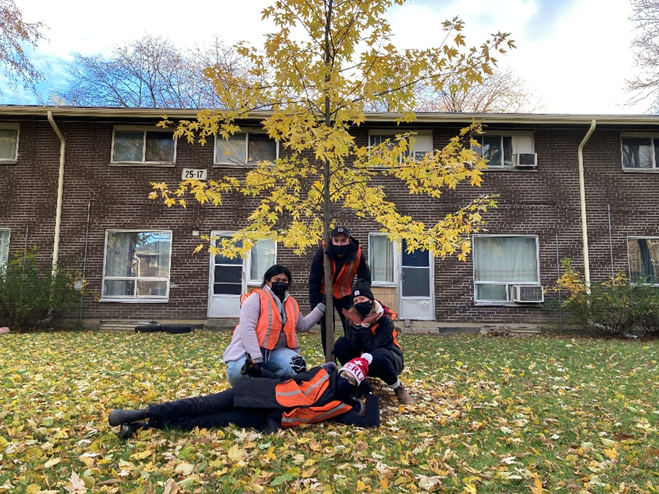
As young trees grow, some may develop minor defects, like crossing or poorly attached branches. Left uncorrected, these defects can worsen into structural issues over time. Our TCHC pruning days focus on identifying and correcting growth defects early on, with the goal of developing long-lived, low-risk, stable trees. This process can also be thought of as training that encourages a tree to grow in a structurally sound way.
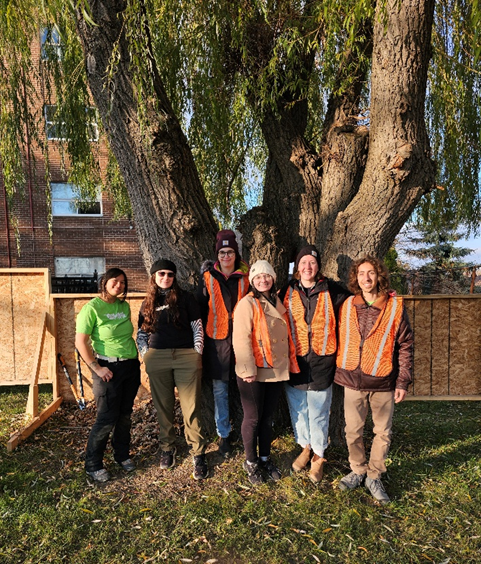
the LEAF team visited six TCHC properties to follow-up on 55 young trees planted in 2023. During the visit, the structure of each tree was evaluated, and pruning was done as needed.
Here are some examples of the structural pruning we do during our TCHC pruning days:
1. Removing crossing branches
Crossing branches rub together, creating wounds that act as entry points for pests and disease. Removing crossing branches prevents damage and improves structure by ensuring branches can grow without obstruction. Removing problematic branches like the one seen below also allows a tree to redirect energy towards growing new, healthy branches.
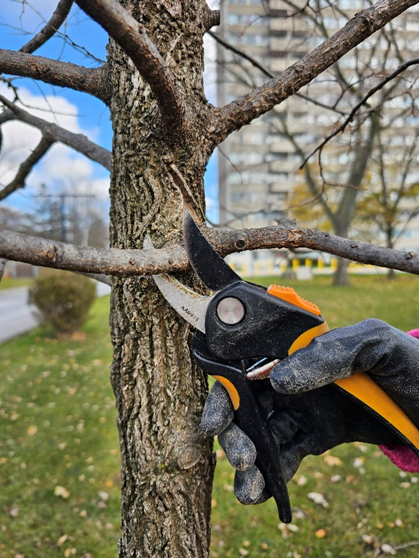
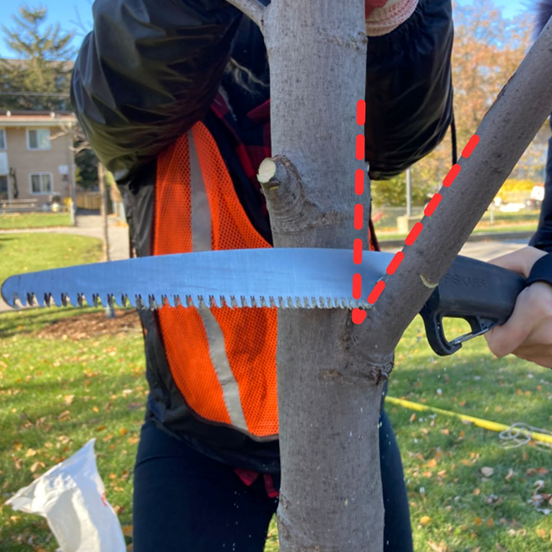
2. Removing poorly attached branches
When a branch is growing at a steep angle from the main trunk (as seen below), it is considered a weak attachment or union. This is because as both the trunk and branch grow, there is higher potential for bark to get trapped within the narrow union. Over time, this trapped bark, called “included bark,” creates less direct connection of the wood tissue between the branch and trunk. This results in a weaker point on the tree that is more likely to fail during high wind and ice storm events. Removing poorly attached branches early on helps reduce the likelihood of branch failure in the future.
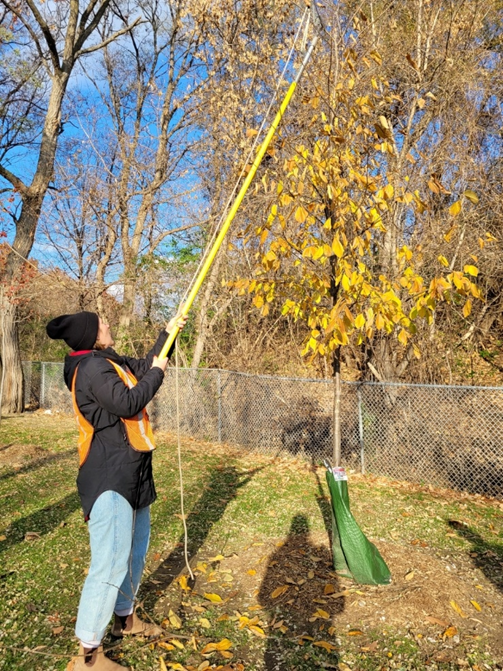
3. Removing multiple leaders
Most tree species should ideally have a single, main upright stem (called a leader). While some trees are great at maintaining a single leader, others may develop more than one. These equal-sized leaders will typically emerge from the same location on the main trunk; however, neither will grow to become dominant. Like poorly attached branches to a trunk, multiple leaders have narrow unions between them, which create structural weak spots over time that are more prone to failure. Because the weak attachment involves the main trunk, failures on this part of the tree can be catastrophic for tree health. Removing all but one leader early on promotes proper form and lowers the likelihood of structural failure.
Annual TCHC pruning days continue to be a fan favourite for the LEAF team. Evaluating and correcting individual trees for minor defects gives our team the hands-on experience they need to fine-tune their pruning knowledge and skills. Pruning days also help support the amazing stewardship work that TCHC tenants provide throughout the year. Working together to provide our young trees with regular care and structural pruning today is the most effective way to encourage the development of long-lived, low-risk and stable trees of tomorrow.
Want to learn more about the TCHC program? You can find more information on our website. If you’re feeling inspired to prune your young tree, check out the International Society of Arboriculture’s (ISA) Pruning Young Trees and Pruning Mature Trees fact sheets for fundamentals on tree pruning and/or connect with an ISA certified arborist to ensure the job is done safely and correctly.
Jess Wilkin is an ISA Certified Arborist and the Residential Planting Programs Operations Supervisor at LEAF
The TCHC Planting and Stewardship Program is implemented by LEAF, TCHC and the City of Toronto. It is funded by the City of Toronto through an Urban Forestry Grant.