
This piece originally appeared in the TGC newsletter, republished with permission from the author.
There were fun and interesting market stalls, delicious food catered from the new Bain Community Kitchen and outside groups, an eco-fair and a performance by the Bain Arts Collective of the Bain Co-op history through pageant of Dance, Music, Shadow Projections, Mask and Giant Puppets. And what a story it is, beginning with the creation of the housing complex by the Toronto Housing Authority, an organization of local philanthropists, businessmen and politicians. Called Riverdale Courts, it was designed by Eden Smith, a well-known architect of the Arts and Crafts movement, and built between 1913 and 1925.
The Bain officially became a co-op in the 1970’s, the beginning of the end of the era when kids were not allowed off the concrete pathways (three violations and you are out), and the courtyards were a barren wasteland of concrete, asphalt, compacted soil and failing grass. Through the efforts of the residents, green and living courtyards became a focal point for community life in the co-op, and today the Bain has won numerous awards for the greening of the courtyards, and has been a leader in waste management with one of the most notable community composting programs in the city.

For a full-sized version, click the thumbnail at the top of this post.
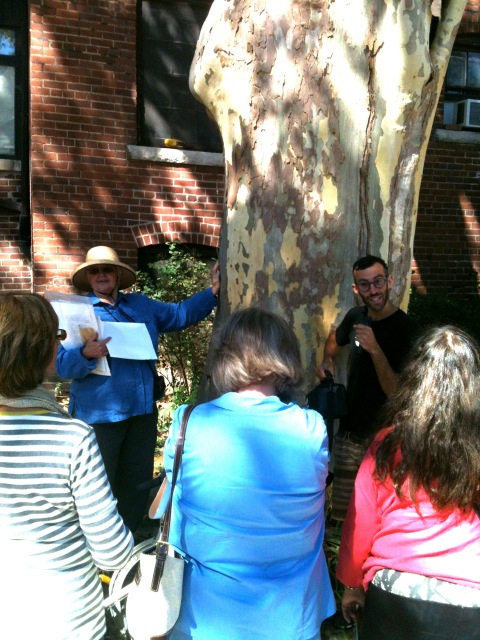
I represented Lost Rivers on a walking tour with Zora Ignjatovic of 100 Bain and Mark Sherman of LEAF - together we told the story of this transformation, of the trees and the gardens that are an edible paradise for children and adults alike. We heard about lost forests, the new urban forest, the lost rivers that once flowed here through a cedar swamp, walked through idyllic organic food gardens and native plantings, and visited the CMHC Healthy House.
The trees at the Bain are a fascinating mix of hard core urban survivors growing between the cracks in the pavement, plus other carefully chosen and nurtured trees that provide shade, cooling, fruit, and beauty throughout. Mark shared tree ID tips and a fascinating story about White Pines and the British Empire. Zora told us about some of the changes since this tour was written, notably the loss of a huge cottonwood, and the impending loss of many ashes as a result of Emerald Ash Borer. The Bain is now in the process of developing its first urban forest management plan.
I talked about the role of trees in the water cycle through a wonderful sound piece. We highly recommend you visit this site to hear the sound of a thirsty tree! The white pine at our first stop “drinks” 100 gals of water a day compared with 60 gallons a day needed by an elephant. Willows are known for their need to be close to water, and can transpire/evaporate 100 to 200 gallons of water on a hot day, so no surprise that the willow we saw is close to the course of Lost Heward’s Creek, with its roots sucking up water from the high water table at that spot.
The tour ended in the South Oaks Courtyard, home to several interesting trees planted by Dagmar Baur, one of the central figures who led the greening of the Bain in the 1970’s continuing into 2009. Dagmar died of ovarian cancer in 2010, and a plaque in her memory was unveiled by Alvyn Austin, author of the words on the plaque, and Mike Nevin keeper of the extraordinary composting system at the Bain. Rhonda Teitel Payne brought spanakopita made with lambs quarters from a recipe devised by Dagmar.
The words on a plaque in the garden say it all:
...When you came, the courtyard was a rubble-strewn wasteland. You and many helping hands transformed it, and you welcomed us into your garden. As long as we shall live in the South Oaks, that will be remembered as Dagmar's garden...
Never underestimate your power to dream and make change, one tree at a time, one community at a time.
Helen Mills is a volunteer with Lost Rivers and a member of Green Gardeners, a sustainable and eco-friendly gardening and landscape company based in Toronto & the GTA.