
Trees do so much for our homes and our communities. They cool our streets, clean our air, reduce energy use, buffer noise, and even boost property values. However, unwelcome visitors can quietly jeopardize tree health. As both new and established invasive threats continue to spread into our neighbourhoods, knowing what to watch for can make all the difference. Here are three invasive threats you should keep on your radar this year.
Spongy Moth (Lymantria dispar dispar)
What is it? The spongy moth is an invasive insect from Europe with established populations in the eastern parts of the United States and Canada, including Ontario. It feeds on over 300 plant species, but prefers oak, maple, birch, alder and hawthorn trees.
How does this pest impact trees? A single spongy moth caterpillar can eat one square metre of leaves in a growing season! Defoliation stresses trees, making them more susceptible to other stressors like diseases, pests and extreme weather. While severe and repeated defoliation can kill trees, they typically do not die from defoliation alone. In years when spongy moth populations surge, affected trees generally become less resilient and can experience a noticeable decline in both their appearance and their ecological benefits.
What are the signs and symptoms of spongy moth?
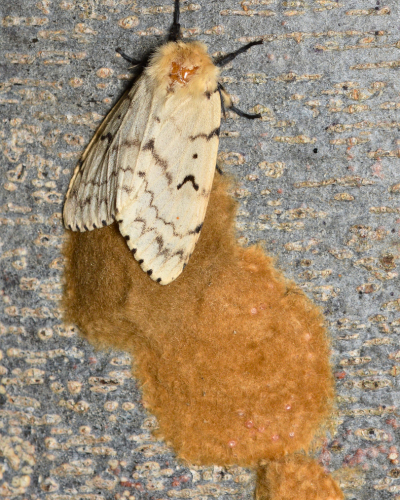
“Female Gypsy Moth (Lymantria dispar) with egg mass – Guelph, Ontario” by Ryan Hodnett is licensed under the Creative Commons Attribution-Share Alike 4.0 International license.
Egg Masses
- Fuzzy, tan-coloured egg masses are laid by adult female moths
- Visible August-May
- Eggs are laid in tree bark and on common outdoor surfaces like fences, vehicles and patio furniture
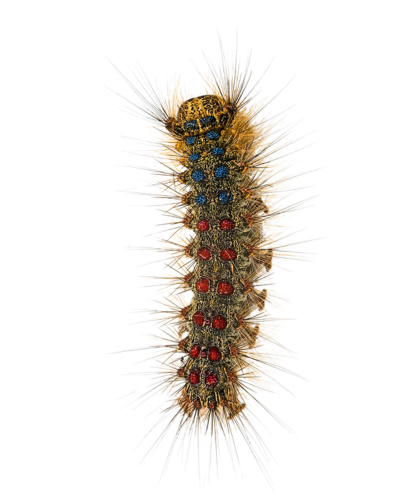
“Lymantria dispar” by Didier Descouens is licensed under the Creative Commons Attribution-Share Alike 4.0 International license.
Caterpillars
- Up to six centimeters long
- Hairy with five pair of blue dots and six pairs of red dots that run along the back
- Visible April - June
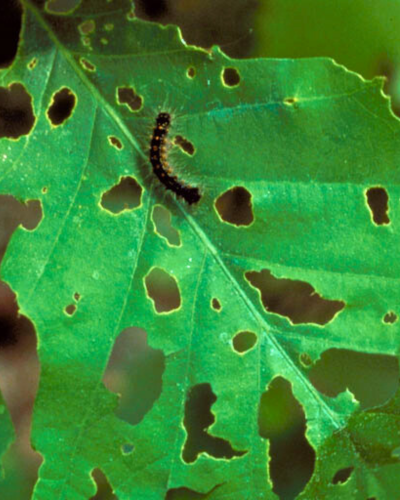
“USDA APHIS Plant Protection and Quarantine, USDA APHIS PPQ, Bugwood.org is licensed under a Creative Commons Attribution-Noncommercial 3.0 License.
Defoliation
- Feeding caterpillars create small holes but may also completely devour a leaf
- Most feeding occurs at night
What can you do?
Spongy moths are unfortunately here to stay, but you can take the following steps to reduce their impact on your trees:
- Monitor trees – Identify trees in your neighbourhood that are vulnerable to spongy moth (listed above) and keep an eye out for signs of the insect. Management efforts are more effective when eggs and caterpillars are detected early.
- Remove egg masses and caterpillars – Scrape egg masses from trees and outdoor surfaces from August through May, and handpick caterpillars from May onwards. Place both into a bucket of soapy water for one to two days, then dispose of them in the garbage.
-
Insecticides – Serious infestations on larger trees may benefit from an insecticide application. Application is time sensitive, so contact an ISA (International Society of Arboriculture) certified arborist for assessment and application as soon as you spot a problem!
Oak Wilt
What is it? Oak wilt is a vascular disease of oak trees (Quercus sp.) caused by the invasive Bretziella fagacearum fungus. While all oak species are susceptible to the disease, those in the red oak group (such as red oak, pin oak and black oak) are more susceptible than trees in the white oak group (such as white oak, bur oak and swamp white oak). To date, oak wilt has been confirmed in three locations in Ontario – the City of Niagara Falls, the Township of Springwater and the Town of Niagara-on-the-Lake.
How does this pest impact oak trees? The fungus grows inside the oak’s living vascular xylem tissues (the tree’s plumbing system), which disrupts the flow of water and nutrients between the roots and the canopy (the aboveground portion of the tree). When these vital resources are cut off, the tree wilts and dies.
What are the signs and symptoms of oak wilt?

“Leaf symptoms” by Robert L. Anderson, USDA Forest Service, Bugwood.org is licensed under a CC BY 3.0 license.
Foliage Changes
- Leaf discolouration begins at the leaf margin (edge) and moves to the middle
- Leaves wilt and bronze, starting from the top of the tree and moving down
- Leaves fall prematurely
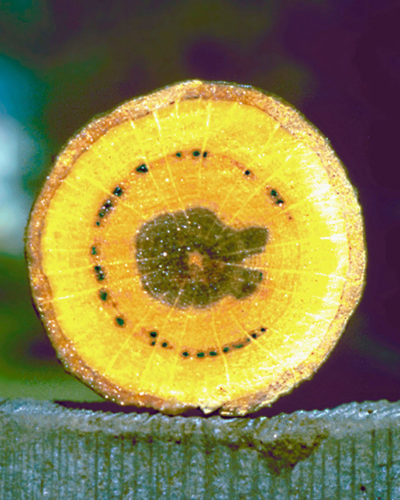
“Vascular discoloration in white oak” by D. W. French, University of Minnesota, Bugwood.org is licensed under a CC BY 3.0 license.
Vascular Staining
- Dark rings (staining) are visible in the cross-section of wood
- Samples can be sent to a lab for genetic confirmation
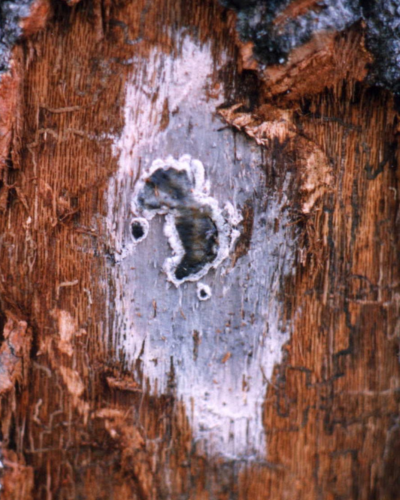
“Spore mat” by Wood Geek is licensed under a CC BY 4.0 license.
Pressure Pads
- White, grey or black pressure pads (fungal mats) are found just below the bark
- May emit a fruity odor
- Pads exert pressure, creating vertical cracks in the trunk
What can you do?
The best way to protect oak trees is by reducing the spread of oak wilt. Here are some things you can do:
- Monitor oaks – Identify oak trees in your neighbourhood and keep an eye out for oak wilt signs and symptoms.
- Do not move firewood – Fungal spores may be present in the wood and can spread oak wilt.
- Prune in winter – Avoid pruning oak trees between April and November, since this is when fungal spores are most likely to spread.
Hemlock Woolly Adelgid (Adelges tsugae)
What is it? The hemlock woolly adelgid (HWA) is a non-native insect from Asia that attacks and kills hemlock trees, primarily the native eastern hemlock (Tsuga canadensis). HWA was first detected in Niagara Falls, Ontario, in 2013 but has since spread to several other Ontario locations, including St. Catharines, Norfolk County and the Greater Toronto Area.
How does this pest impact hemlock trees? HWA attaches its mouth to the base of a hemlock needle and sucks out the tree’s nutrient-rich sap. Despite being just the size of a grain of ground black pepper, the tiny HWA reproduces prolifically, quickly leading to infestation. As HWA feeds, it drains the tree’s energy and blocks the flow of nutrients and water to the needles. This causes premature needle drop, which prevents photosynthesis (a tree’s food-making process) and ultimately causes the tree to starve to death.
What are the signs and symptoms of HWA?
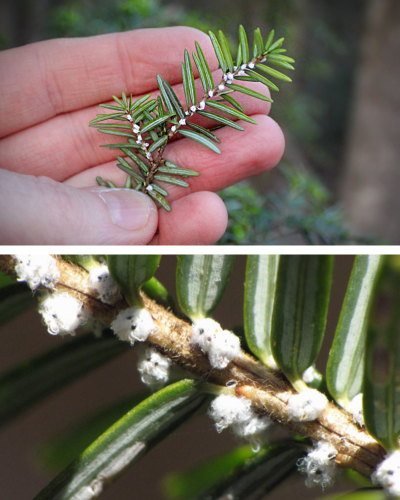
Left (top): “Jakey Hollow Natural Area” by Nicholas A. Tonnelli is licensed under the Creative Commons Attribution 2.0 Generic license. Left (bottom): “Woolly Adelgid Infestation” by BlueRidgeKitties is under the Creative Commons Attribution 2.0 Generic license.
Egg Sacs
- Tiny, white "woolly" egg sacs are visible to the naked eye
- Found on the underside of branches near the base of needles
- Visible November - May
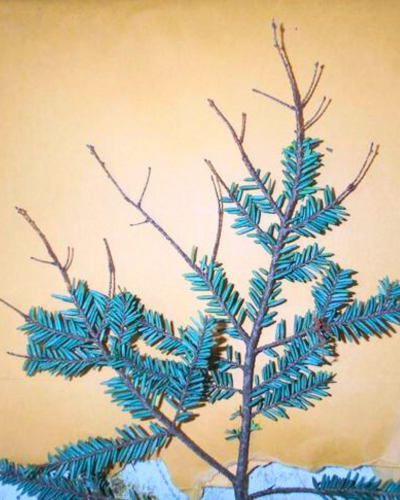
“Hemlock woolly adelgid (Adelges tsugae Annand, 1924)” by David Mausel, Virginia Polytechnic Institute and State University, Bugwood.org is licensed by licensed under a Creative Commons Attribution-Noncommercial 3.0 License.
Foliage Changes
- Premature needle loss
- Dark green needles become greyish-green
- Thinning canopy
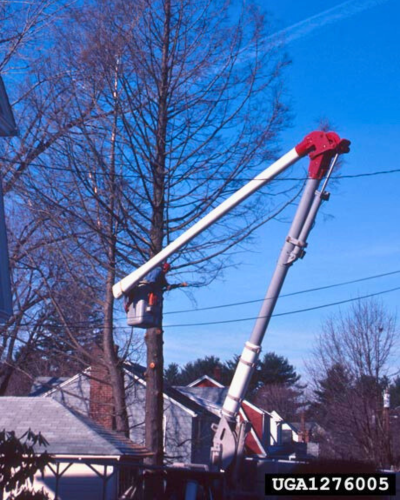
Michael Montgomery, USDA Forest Service, Bugwood.org is licensed under a Creative Commons Attribution-Noncommercial 3.0 License.
Death
- Death of new needle growth
- Dieback of twigs and branches
- Complete death of the tree, which can occur in as little as 4-15 years
What can you do?
The best way to protect hemlock trees is by reducing the spread of HWA. Here are some things you can do:
- Avoid bird feeders on/near hemlock trees – HWA loves to hitch rides on birds to new locations.
- Do not move firewood – Transporting firewood of any species can increase the spread of HWA.
- Monitor hemlocks – Identify hemlocks in your neighbourhood and inspect them for woolly sacs.
Best Practice Tips for Managing Invasive Threats
Here are three best practices to help reduce the spread of invasive threats and keep your trees healthy:
- Tune in for updates – Municipal and regional governments and conservation authorities often monitor and forecast spongy moth populations, so checking their websites early in the year is a great way to prepare. The Invasive Species Centre also provides timely updates on emerging threats like oak wilt and HWA.
- Report sightings – Early detection of invasive species like oak wilt and HWA can help limit their spread and damage (there is no need to report spongy moth as it is already fully established). If you suspect a tree has oak wilt or HWA, report it through the Canadian Food Inspection Agency (CFIA), the Invasive Species Hotline at 1-800-563-7711 or the EDDMapS app or website.
-
Provide regular care – Regular watering, composting and mulching will reduce stress and help trees stay resilient. For young trees, water twice per week—spring through fall—using approximately six gallons each time (that is equivalent to three full watering cans twice per week, or using a hose with no nozzle on a very slow trickle for approximately 15 minutes twice per week). For established trees (planted for three or more years), water as needed, especially during dry periods.
Adding a healthy layer of organic compost beneath a layer of natural wood-chip mulch (approximately two to four inches deep) will provide your tree with nutrients over time, helping reduce stress and encourage healthy tree growth. It is important to lay compost and mulch in a doughnut shape around the tree, ensuring neither touches the trunk, as this can promote rot.
Early detection and simple actions by residents can make a real difference in protecting our yards and urban forests from invasive threats like spongy moth, oak wilt and hemlock woolly adelgid. Regular monitoring, proper tree care and responsible firewood management will help keep your trees¬—at home and across your neighbourhood—healthy and resilient. If you have questions about your LEAF-planted trees or would like guidance on managing invasive species, contact LEAF or an ISA-certified arborist.
Jess Wilkin is the Residential Planting Programs Operations Supervisor and an ISA-certified arborist at LEAF.
LEAF offers a subsidized Backyard Tree Planting Program for private property. The program is supported by the City of Toronto, the Regional Municipality of York, the City of Markham, the Town of Newmarket, the City of Vaughan, the Regional Municipality of Durham, the Town of Ajax, the Municipality of Clarington, the City of Oshawa, the City of Pickering, the Township of Scugog and the Town of Whitby.