
Located on private land, in the laneway between Brunswick Ave and Major St, behind the Kensington Gardens, this tree is a legacy tree, stretching over multiple properties. “It’s so cool because it's so huge!” -- Sandy exclaimed. Few mature trees remain in the Harbord Village due to the density of these downtown areas, but this tree has managed to survive, which is what makes it all the more special.
This tree first “appeared” on Sandy’s radar in 2007, after the Harbord Village Resident’s Association, her neighbourhood R.A., did their first Neighbourwoods tree inventory.
“One of the students came back from a day out tree measuring and remarked on the size of the tree. When I found out that it was literally ‘in my backyard', one street behind my house, I went over myself and was equally impressed with its size and survival in the heart of the downtown core.”
There’s no doubt this tree has lived through our city’s history since Toronto was founded in 1834. Prior to residential development, this area was ‘market gardens’, where food was grown in open fields to feed the city. The open branching and spread of the Bur Oak’s canopy indicates that it was clearly present during, if not before, this time. The neighbourhood was subdivided in the 1880’s and this Bur Oak remained standing tall through the city’s expansion. “When I first saw the tree, it was very large (Andy Kenney and I estimated at least 250+ years old), healthy and growing in a large, undisturbed, open backyard. There had been essentially nothing done to the property for almost 100 years-- no parking pad, no garage nor shed, no conflicting wires, no competing vegetation or trees, and no cutting/pruning because it was at the back of the property”. Luckily having a long-term, low impact landlord for over 50 years helped it survive the tough living conditions in the city.
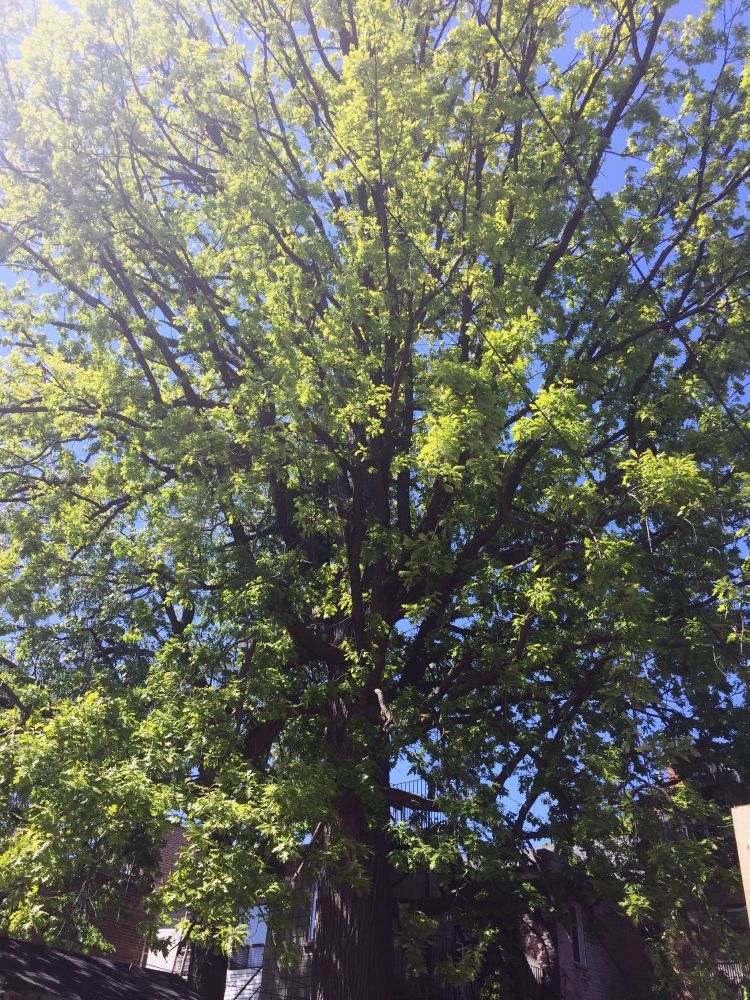
When asked what category Sandy Smith would nominate this Bur Oak, “All of them!”, she says, and I couldn’t agree more. Unfortunately over the past few years there has been extensive construction on the property, and the Bur Oak is now starting to show signs of stress with thinning in the upper most branches, but ultimately this tree is a true survivor.
There’s no doubt that we are lucky to still have this gem in our presence, so if you’re in the area, make sure to visit the mighty Bur Oak, one of our city’s greatest trees!
Dr. Sandy Smith is a Professor in the Faculty of Forestry at the University of Toronto where she was Dean (2010-2012). She specializes in forest health and working with nature to solve our invasive challenges, especially in cities where non-native invasive insects often enter our forest systems. Sandy is also a strategic advisor for LEAF, is on the Toronto Parks and Trees Foundation Board, and the Ontario Invasive Plant Council. She has also served on the Science Panels for the Asian Long-Horned Beetle and the Emerald Ash Borer, and carries out biocontrol research for managing invasive plants such as dog-strangling vine, knotweed and Phragmites.
The Great Toronto Tree Hunt is supported by TD Friends of the Environment Foundation along with Ontario Power Generation and City of Toronto.