
In August 2024, my friend Emma Durand Wood, one of the co-founders of Trees Please Winnipeg, approached me about writing a book on the urban forest. It would be part of The City Project, a series of compact, accessible books exploring everything from city finances, active transportation and urban trees to the decolonization of public spaces.
My first reaction was a feeling of high anxiety, despite the fact that I’d already written more than a dozen op-eds for the Winnipeg Free Press on why our city needed to invest more in the maintenance, protection and expansion of our urban canopy and greenspaces.
How, I wondered, could I possibly jam not only the history of Winnipeg’s canopy, but everything I knew about the power and benefits of urban trees into just 120 pages? How could I convince my readers that urban forests and greenspaces are one of the most effective, equitable and natural solutions available to enhance urban climate resiliency and protect biodiversity?
After a few weeks of dithering, I finally decided to give it a try, and in the end, Out On A Limb became one of the happiest writing experiences of my career. This was partly because it gave me an opportunity to write about the astonishing benefits of mature urban trees, including their amazingly positive impact on human health. But it was also because it offered a chance to celebrate the many nonprofit and volunteer organizations in Winnipeg and elsewhere – like LEAF in Toronto – that are busy planting and defending their urban trees and natural forests.
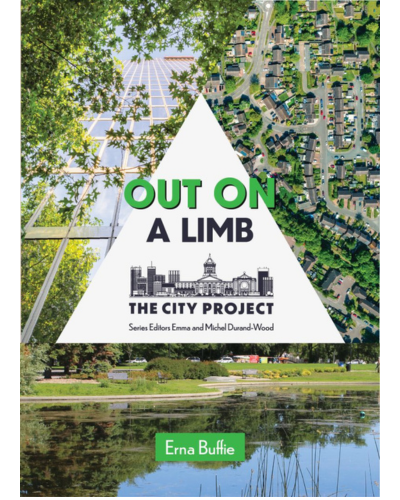
One of the main challenges of the book was to use Winnipeg as the central case study while also broadening the lens to compare what was happening here with other cities in North America and around the world. To my surprise, I quickly discovered that the problems facing Winnipeg are shared by many cities across North America.
The research revealed an overall decline in urban forests across the continent, partly due to new pests and diseases, but primarily due to a lack of funding. Most urban forestry departments simply didn’t have sufficient cash to properly maintain their urban canopies or replace the public trees that were being lost.
That was particularly true in Winnipeg, which, by 2021, was in the midst of an urban forest crisis. In just three years, from 2018 to 2021, we had lost some 46,000 public trees and had a staggering 80% tree replacement backlog.
In other words, for every three trees lost, only one was being replaced.
Our challenge was to make those losses, spread out across an entire city, visible to the mayor and city councillors who seemed in denial about the crisis. Thankfully, we were able to remedy that with the help of Trees Please Winnipeg member Chris Green, an epidemiologist who offered to crunch the numbers.
Using the city’s open data source, combined with other reliable statistics, he was able to show exactly how many trees had been lost between 2015 and 2021 in every electoral ward in the city. The results were astonishing. Some wards had lost more than 4,000 trees in just five years, and only one, a new suburb, had actually gained tree cover.
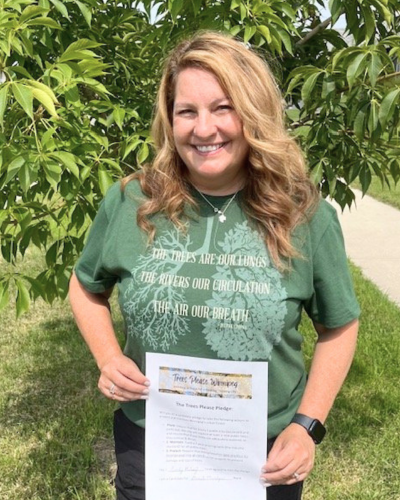
With a 20-year urban forestry strategy nearing completion, and a civic election scheduled for 2022, Trees Please decided to use that data to convince mayoral and council candidates to sign on to what we called “The Trees Please Pledge.”
That pledge committed candidates to planting two trees for every tree lost, pruning our trees on a seven-year cycle (instead of every 30 years!) and establishing better practices to protect trees during construction.
Most candidates were visibly shocked by the data we presented and, in the end, our new mayor and all but one of the newly elected councillors signed the pledge. More importantly, they followed through on their promises in their first four-year budget, by increasing urban forestry funds by a whopping 45%.
It was an important win, but unfortunately, lack of funding isn’t the only problem facing urban trees.
Construction and development have had and continue to have a devastating impact on urban forests, most of which sit on privately owned land. Indeed, studies have shown that in most North American cities, the public tree canopy accounts for only a fraction of the urban forest. The bulk of trees and natural forests rest in private hands.
As a result, Winnipeg has lost tens of thousands of trees to make way for development – losses that the city isn’t even counting.
In an effort to remedy that, a number of Canadian cities, like Toronto, have enacted private tree bylaws. But in this, as in so many other aspects of green planning, Winnipeg lags behind. As a result, Trees Please still has a lot of work to do.
A big part of that work is educating governments and the public about the benefits of urban canopies and encouraging them to learn from cities that have already prioritized green planning and designated trees as essential urban infrastructure.
I can only hope that Out On A Limb contributes to that educational process and facilitates some interesting and important conversations about the pivotal role trees can play in making our cities safer, healthier and more climate-resilient.
Erna Buffie is the author of Out On a Limb. The book is part of The City Project, a series edited by Emma and Michel Durand-Wood. You can order the book here, as well as on Amazon and other bookstores. Erna is a writer and environmental activist who worked as a filmmaker for CBC’s The Nature of Things for 20 years. You can read her op eds and learn more about her films and books on her website.