
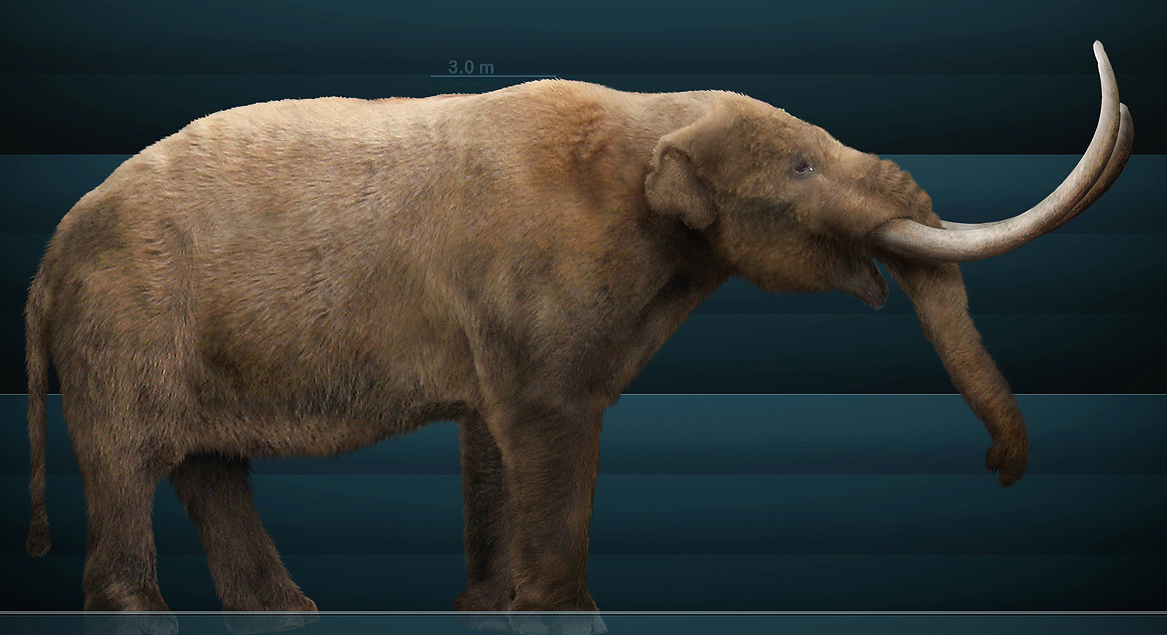
The late Pleistocene epoch (which ended about 11,700 years ago) shaped a landscape in Ontario and across North America that was vastly different from today. This Ice Age world was home to giant herbivorous mammals, including American mastodons, woolly mammoths, Jefferson’s ground sloths, and extinct large deer species, which played a key role in shaping the habitats they roamed.
Some trees that survive today were influenced by these giants and carry the legacy of a world shaped by their presence. The fruits they bear are living clues to this different past.



Fruits Out of Time
While most existing trees and shrubs have fruit perfectly suited to modern wildlife, some trees have anachronistic fruits – fruits and seeds meant to be eaten and dispersed by giant mammals. These fruits are often too large, tough or specialized for animals that live today. They are evolutionary leftovers from a world long gone.
Research on fruit evolution shows that features like large fruit size and tough seed casings are consistent with adaptations for dispersal by extinct megafauna, and with the disappearance of megafauna, largely due to climate shifts at the end of the Ice Age and human hunting, many tree species lost the animals that once carried their seeds far and wide.
Megafauna-Adapted Trees in Ontario Today
Some of the trees that live today still bear fruits that tell the story of these extinct dispersers.
Here are a few you might recognize:
Native to Ontario

Kentucky coffeetree (Gymnocladus dioicus) produces seed pods that researchers believe were eaten by large Pleistocene mammals, especially mastodons. These pods are large and tough on the outside, but the insides are fleshy and nutritious. What is too tough for most modern animals to eat could easily be crushed and swallowed by mastodons. Mastodons would eat the fleshy pods for their nutritious pulp, with the seeds passing through their digestive system in the process. The seeds would benefit from this because the animal’s stomach acid would help weaken or break down the hard outer coat (a process called scarification) so that, once excreted, the seeds could absorb water and germinate.

Honey locust (Gleditsia triacanthos) trees are similar to Kentucky coffeetree: both have large, tough seed pods that were likely eaten and dispersed by extinct megafauna. The main difference is that while modern animals rarely eat Kentucky coffeetree pods, some wildlife including deer, squirrels and livestock will nibble on honey locust pods today.

Pawpaw (Asimina triloba) produce large, soft, greenish-yellow fruits with a sweet, custard-like pulp. Unlike Kentucky coffeetree and honey locust, pawpaw fruits are soft enough for both people and animals to eat, including raccoons, squirrels and opossums. However, the large size of the fruits suggest they were originally adapted to be eaten by extinct megafauna, which would have carried the seeds over long distances.
Native to Eastern North America, but not Ontario
The next two trees are occasionally planted in Ontario but are not native to here.

Osage orange (Maclura pomifera) trees produce large, bumpy, bright green fruits that were likely eaten by giant herbivores. The fruits are too tough for most modern animals to eat, but their size and fibrous pulp would have made them an ideal snack for megafauna capable of crushing and swallowing them whole.

American persimmon (Diospyros virginiana) trees produce sweet, sizeable fruits that were adapted for consumption by ancient megafauna. Today, birds and smaller mammals eat the pulp, but the seeds are large and hard relative to the pulp, making them difficult for most modern animals to eat and carry.
Tropical areas of North or South America
Other true anachronistic fruit trees found in tropical or subtropical regions of the Americas include wild avocado (Persea americana), calabash (Crescentia alata and Crescentia cujete), and large-fruited tropical trees like mamey sapote (Pouteria sapota).
Why Losing Their Megafauna Matters
With their original megafaunal dispersers gone, these trees face challenges that weren’t part of their evolutionary history. Seeds that once traveled long distances now mostly fall close to the parent tree, limiting the spread of these species and the habitats they can colonize. In some cases, natural processes like wet soils or small animals help a little, but they rarely replace the role of giant herbivores.
The loss of these animals helps explain why some of these trees are now rare or endangered and often survive mainly in scattered or human-planted locations (though factors like habitat loss, human activity and competition from other plant species also play a significant role).
Connecting Past and Present
The next time you’re walking through your neighbourhood, keep an eye out for these trees. Kentucky coffeetree, pawpaw, honey locust and others are living reminders of a time when giants shaped the landscape. Though these fruits no longer have their natural long-range dispersers, we can help continue their story. Visit our Homeowners page to start planting one of these trees and bring a piece of Ice Age ecology into your backyard.
Justin Lewis is the Marketing and Communications Lead at LEAF.
LEAF offers a subsidized Backyard Tree Planting Program for private property. The program is supported by the City of Toronto, the Regional Municipality of York, the City of Markham, the Town of Newmarket, the City of Vaughan, the Regional Municipality of Durham, the Town of Ajax, the Municipality of Clarington, the City of Oshawa, the City of Pickering, the Township of Scugog and the Town of Whitby.