Home
  • Search
  • Newsletter Sign-Up
  • Donate
  • About
    • About Us
    • Board of Directors
    • Our Team
    • Supporting Partners
    • Awards
    • Annual Reports
    • Employment Opportunities
    • Contact Us
  • Plant
    • Homeowners
    • Multi-Units & Businesses
    • Shrubs, Cedars & Pawpaws
    • Species Offered
    • Toronto Community Housing
    • Housing York Inc
    • Schools
  • Learn
    • Young Urban Forest Leaders
    • Young Ravine Leaders
    • Tree Tenders Training Course
    • Presentations & Tree Tours
    • Backyard Biodiversity
  • Volunteer
    • Become A Volunteer
    • Community Tree Planting & Stewardship
    • Urban Forest Demonstration Gardens
  • Events
  • News & Shop
    • Blog
    • Newsletter Sign-Up
    • Media Coverage
    • Media Releases
    • Gift Certificates
  • Resources
    • Planting Program Brochures
    • The Urban Forest
    • Tree & Shrub Health & Care
    • Ontario Residential Tree Benefits Estimator
    • GIO Coalition
    • Green Prosperity
    • Canada's Urban Forestry Footprint
    • Urban Wood Utilization

The Most Colourful Time of the Year

  1. Home
  2. Blogs

September 17, 2019 by Visitor

Fall marks a time of many magical changes. Trees that were once lush green transform into brilliant shades of yellows, golds, oranges and reds, creating an extraordinary spectacle. But, have you ever wondered why some leaves turn yellow while others lend themselves to bright reds? The mixture of the vibrant fall colours we see is actually a result of complex chemical processes that take place inside the tree as the season changes from summer to winter.


Sugar maple street tree starting to turn colours(© 2016 Brenna Anstett / LEAF)


During the spring and summer months, leaves serve as food factories for trees. Leaves produce food by capturing the sun’s energy and combining it with a green pigment called chlorophyll, which gives leaves their green colour throughout the spring and summer. The leaves then use this energy to convert water and carbon dioxide into oxygen through a process called photosynthesis. But, in the fall, environmental cues, such as changes in the length of daylight and temperature, begin to slow down this process. As photosynthesis begins to decrease,
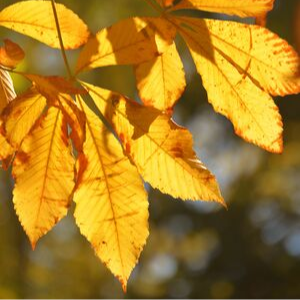
Golden Ohio buckeye leaves(© 2016 David Slaughter / LEAF)
the chlorophyll breaks down and the green colour begins to disappear.


As the green colour fades, underlying colour pigments are revealed. The fall colour of leaves is made up of the different proportions of these pigments. The yellow and orange pigments in leaves are known as carotenoids. Carotenoids are always present in leaves, but, because chlorophyll levels are very high during the spring and summer months, they are often concealed. Carotenoids help chlorophyll absorb light energy for use in photosynthesis during these months. But, in the fall, as the green disappears, the carotenoids start to show their real colours. 
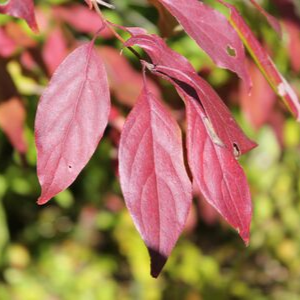
 

Purple-ish, dark red-ish grey dogwood leaves(© 2016 Brenna Anstett / LEAF)


Some tree species further their colorization process by chemically producing a secondary pigment called anthocyanin, which are the reds, purples and even blue colours you see in the fall. Unlike carotenoids, anthocyanins are not automatically present in leaves but are created when chlorophyll is degraded. Additionally, anthocyanins require sunlight for production and thus are only primarily produced in exposed leaves. That said, the levels of anthocyanin pigments can fluctuate from year to year due to the influence of pH levels in the soil, soil moisture, sunlight and temperature. If warmer temperatures persist into the fall or if there is a severe drought, the change in fall colour as well as the intensity can be slowed down.
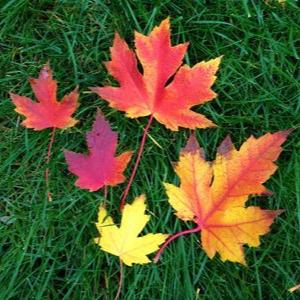
Freeman maple leaves of different colours(© 2016 Brenna Anstett / LEAF)
Similarly, a severe frost early in the season can cause leaves to turn brown and prematurely fall.


Ultimately, the process of fall leaf colour change is very complex and there is no magic formula to predict exact fall colour. Trees are living beings and, because many factors can influence fall colour, there is no way to guarantee you will see the same thing year after year! The colours we do see, though, are a truly spectacular gift. And now, the next time you take a walk amongst the trees to take in their beauty, you’ll be able to appreciate the complex processes and elements that create those enchanting colours!


Natasha Keshavjee is the Residential Planting Programs Operations Supervisor at LEAF.


The Backyard Tree Planting Program is supported by the City of Toronto, the Regional Municipality of York, the City of Markham, the Town of Newmarket, the Town of Ajax, Toronto Hydro and Ontario Power Generation.


Blog Tags: 
BYTP
  • Contact Us
  • Privacy Policy
  • Site Map
  • LEAF Blog
  • Newsletter sign-up

© 2011-2026 LEAF - Local Enhancement & Appreciation of Forests

© All photos, graphics and images on this site remain the copyright of LEAF and should not be downloaded without prior permission.