
Just like people, trees benefit from a little guidance while they’re young. With some light structural pruning early on, you can help them grow into long-lived, stable trees. One of the most common issues to watch out for in your young trees is the formation of co-dominant stems.
What are Co-Dominant Stems?
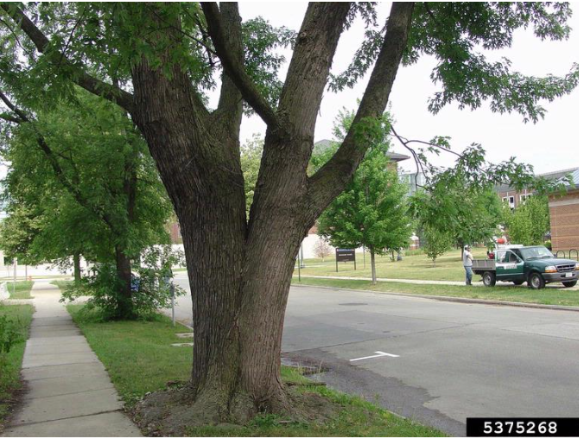
Co-dominant stems are two or more competing, same-sized branches (stems) that grow upward together from the same point on the main trunk.
This structure is very common in young trees and can occur naturally in just about any species. However, trees planted in open, sunny areas or those with more naturally upright growth patterns, such as maples (Acer), lindens (Tilia), oaks (Quercus) and elms (Ulmus), are typically more prone to developing multiple competing stems. At first glance, it may not seem like an issue, but as a tree grows, these competing stems can create structural weaknesses that threaten its strength and stability over time.
Understanding “Included Bark”
A key concern with co-dominant stems is something called “included bark.” To better understand what this is, we need to first look at how a tree branch connects to the trunk. You can think of this connection as two pieces of wood glued together at an angle, forming a joint. As the tree grows, it keeps adding new wood around that joint, making it thicker and stronger over time.
Ideally, branches should connect to the trunk in a wide, U-shaped angle, anywhere from 45–90°. As both the trunk and the branch produce new wood each year, the wide angle allows the growth layers to overlap and interlock, forming a strong, durable joint that can better support the weight of the canopy and withstand stress from wind and snow.
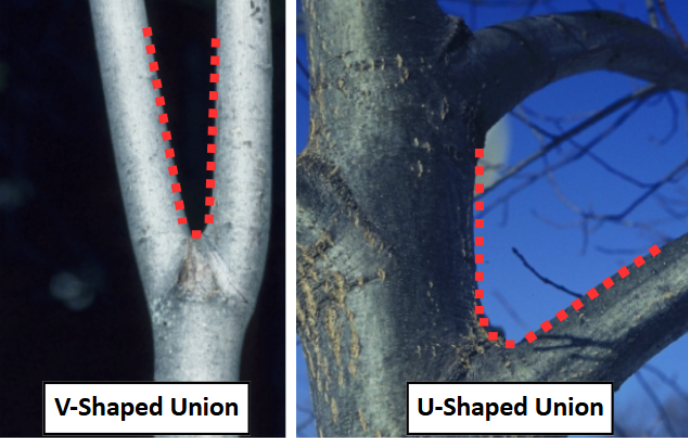
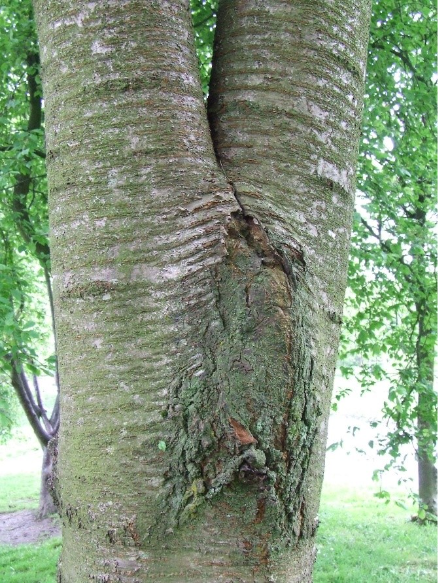
Co-dominant stems develop when two branches grow close together at a narrow, V-shaped angle, typically less than 45°. As each stem grows, bark can become trapped in the tight space between them, preventing them from forming the strong, durable joint that forms at wider angles. This trapped bark is known as included bark. Over time, the co-dominant stems push against each other as they thicken, which can lead to cracks and a weak branch attachment point that is more likely to fail under the weight of the canopy or stress from wind and snow.

Why Should You Fix Co-Dominant Stems?
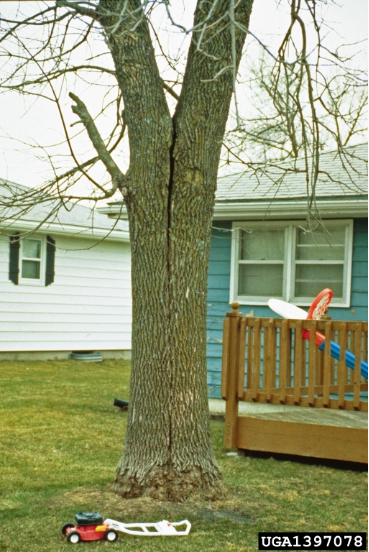
Correcting co-dominant stems on a young tree can prevent larger structural issues as the tree matures. Remember: the weak attachment between co-dominant stems is more likely to split during storms, heavy winds or ice events, especially as the branches become larger. Preventative pruning of co-dominant stems reduces the risk of breakage during storms, heavy winds or ice events, which in turn:
Protects people and property – branches that split and fall can pose a risk to people and cause damage to nearby homes, vehicles and other property.
Promotes long-term tree health – large wounds created by breaks or by pruning when branches become too large can cause trees stress and become entry points for pests and disease. Early pruning keeps problematic stems from growing too big and splitting, reduces the need to remove large branches later and decreases entry points for pests and diseases.
Improves tree structure – removing a competing branch encourages a tree to grow a single main stem, which helps develop a balanced canopy and stronger branch attachments.
How Do You Fix Co-Dominant Stems?
Correcting co-dominant stems through pruning encourages one branch to become dominant, creating a single, central stem over time.
There are two options for corrective pruning techniques, depending on the size of the co-dominant stems:
Removal – competing stems are removed entirely at once, leaving only one stem. This cut is most appropriate when a tree has small co-dominant stems.
Subordination – the length of competing stems is gradually reduced over a couple of growing seasons with multiple pruning cuts, until there is only one remaining stem. This cut is most appropriate when a tree has larger co-dominant stems that make up a bigger percentage of the canopy.
When pruning, it’s important to keep in mind that you should not remove more than 25% of the live canopy at one time, as removing more can cause stress to a tree.
Regardless of the technique used, proper pruning cuts are essential. The International Society of Arboriculture’s (ISA) Pruning Young Trees and Pruning Mature Trees factsheets are excellent resources to help guide you through the fundamentals of pruning, including what tools to use and where to make a cut. For larger pruning jobs, it is best to hire an ISA-certified arborist. You can check out our blog for tips on selecting a qualified tree care company.
Co-dominant stems are a very common problem among young trees and can have serious consequences if left unmanaged. But luckily, they are also very easy to address – by keeping an eye on your trees and prioritizing structural pruning when they are young, you can set them up for a long, healthy life!
Do you have a young LEAF tree that you think needs structural pruning? We offer a Standalone Pruning Service for LEAF-planted trees under 14 feet (four meters). And if you’re interested in learning more about tree care, visit our Tree & Shrub Health & Care page for more information.
Jess Wilkin is the Residential Planting Programs Operations Supervisor and an ISA-certified arborist at LEAF.
LEAF offers a subsidized Backyard Tree Planting Program for private property. The program is supported by the City of Toronto, the Regional Municipality of York, the City of Markham, the Town of Newmarket, the City of Vaughan, the Regional Municipality of Durham, the Town of Ajax, the Municipality of Clarington, the City of Oshawa, the City of Pickering, the Township of Scugog and the Town of Whitby.