
When you fall and scrape your knee, your body goes to work healing the damaged tissue. It uses platelets to form a scab, it sends white blood cells to fight off germs and it grows new skin. Your body repairs itself. But, when a tree’s tissue is damaged by a physical injury (e.g., pruning cut or lawnmower damage), fungi/pathogen or pest, it can’t replace the injured tissue or heal itself the same way a human can. For trees, injured wood stays damaged forever. So how do trees manage to survive?
Trees take a different approach to dealing with injuries. Instead of healing, they expertly manage damage by containing it so it can’t spread. Imagine a tree as a giant wood apartment building with lots of units. If one unit gets damaged by a fungus, the tree doesn’t rebuild the unit; instead, it walls it off so that the damage doesn’t spread to the rest of the building. This “walling off” process is known as CODIT, which stands for Compartmentalization Of Decay In Trees.
CODIT may sound complex, but it’s actually a straightforward (and fascinating) process. When a tree is damaged, it undergoes changes that establish internal barriers, called “walls,” that slow and block the spread of decay or infection. There are four walls:
Wall One – The Vertical Wall
This wall slows the spread of decay or infection up and down the trunk. It’s made of plugged vascular tissues above and below the wound. While it does help to protect the tree, it’s considered the weakest wall.
Wall Two – The Inward Wall
This wall slows the spread of decay or infection toward the centre of the trunk. It’s made of latewood, which is the dense part of the tree’s annual growth ring that is formed during the late summer and fall when growth slows. This is considered the second weakest wall.
Wall Three – The Side Wall
This wall slows the spread of decay or infection laterally in the trunk. It’s made of ray cells (specialized living cells in woody plants), which run horizontally from the centre of the tree to the outside bark. This is considered the second strongest wall.
Wall Four – The Barrier Zone
This wall forms after the injury. It’s made of new wood that grows on the exterior of the tree and can seal off the wound. This is considered the strongest wall.
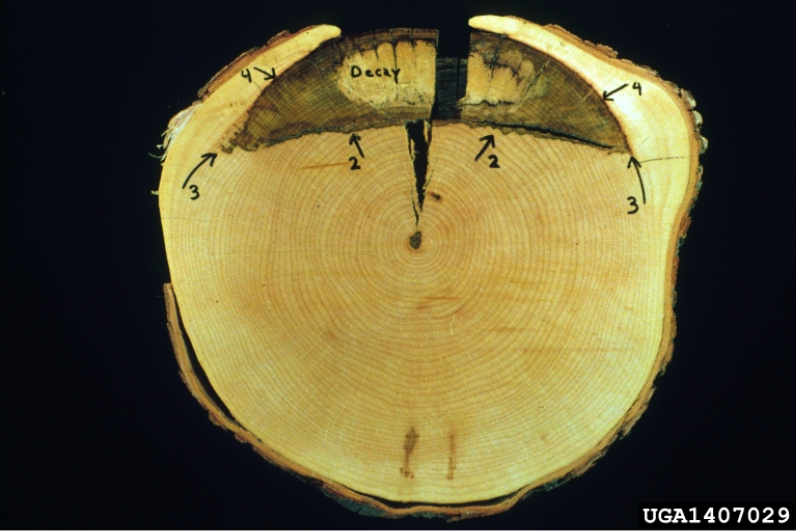
©2003 USDA Forest Service - Northeastern Area
A cross-section of a tree trunk showing walls two, three and four involved in the CODIT process. Wall one is not visible in this view, but would be positioned above and below the labelled area of decay.
CODIT helps explain how trees can develop hollow areas in their trunks and still survive. Let’s go back to the analogy of the wood apartment building. When the four defensive walls trap decay inside one apartment unit, the decay can’t spread to other areas, but it will continue to rot the wood within the unit. This eventually creates a hollow space.
Wound Wood
When you look at a tree that was injured years ago, you might notice a smooth ring of wood wrapping around the old wound. This is called “wound wood” and should not be confused with healed tissue. Remember: trees don’t heal, they seal. What you are seeing is the fourth wall created in CODIT – the Barrier Zone. Behind that new wound wood is the decayed, damaged wood.
Wound wood grows from the edge of the injury and slowly rolls inward. It can take years for a wound to close and in cases where a wound is very large, it may never close completely.
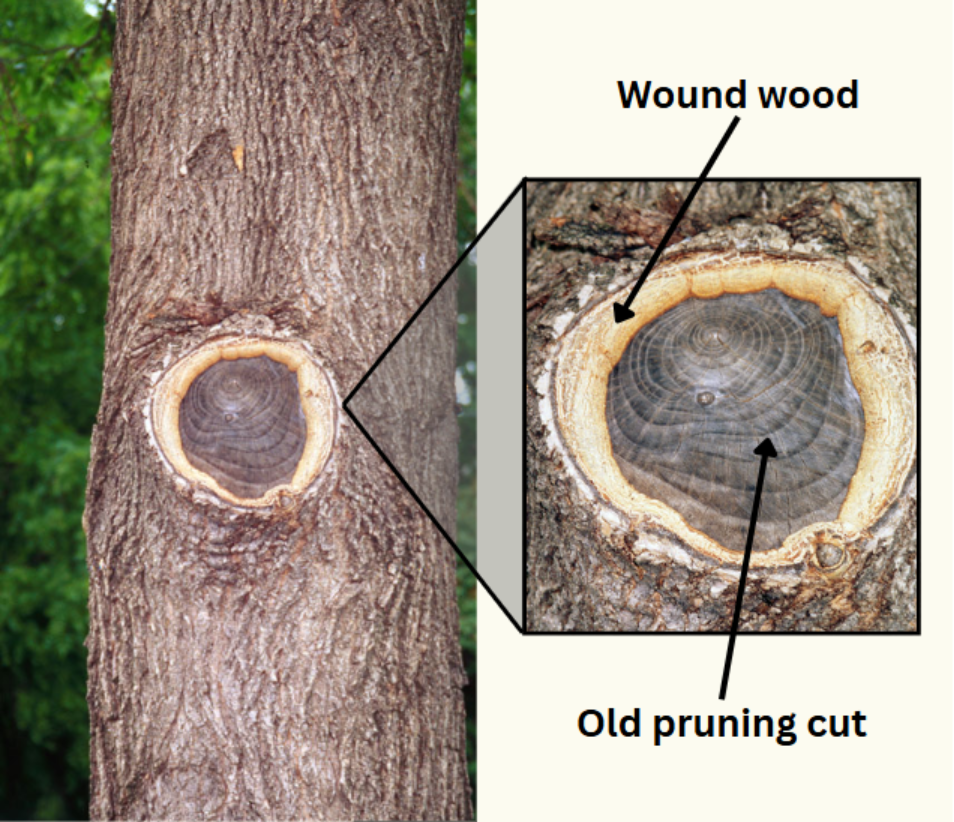
©2005 Dennis Haugen
Wound wood forming around an old pruning cut on a green ash (Fraxinus pennsylvanica) tree
Not All Trees Manage Damage the Same Way
A tree’s ability to compartmentalize its wounds by building walls can be influenced by different factors, including environmental and genetic. Environmental factors such as stress, soil conditions and drought impact a tree’s health and vigour, in turn affecting its resilience. At the end of the day, a healthy, vigorous tree is one that has more energy to invest in defence. Some tree species are naturally better at compartmentalization than others. For example, oak species are considered stronger compartmentalizers than willow species.
The nature of an injury can also affect how well the compartmentalization process works. That’s why proper pruning practices are so important!
Pruning
The location and size of a pruning cut impact a tree’s ability to seal it. Pruning cuts should be made just outside the “branch collar,” which is the swollen area at the base of a branch where it attaches to the trunk or another branch. The branch collar produces chemicals that prevent pathogens from entering the tree and has specialized cells that help the sealing process. Cutting into the branch collar, or too far away from it, reduces its ability to effectively seal the wound.
A good pruning cut is small, clean (with no rough edges) and made just outside the branch collar. These cuts are quicker and easier for the tree to seal off, helping limit how far decay can spread into surrounding areas such as the trunk or other branches.
In contrast, a bad pruning cut may be large, uneven, or flush with or too far from the trunk or branch. These cuts are slower and more difficult for a tree to seal, increasing the risk of decay or infection spreading into other areas and causing more damage.
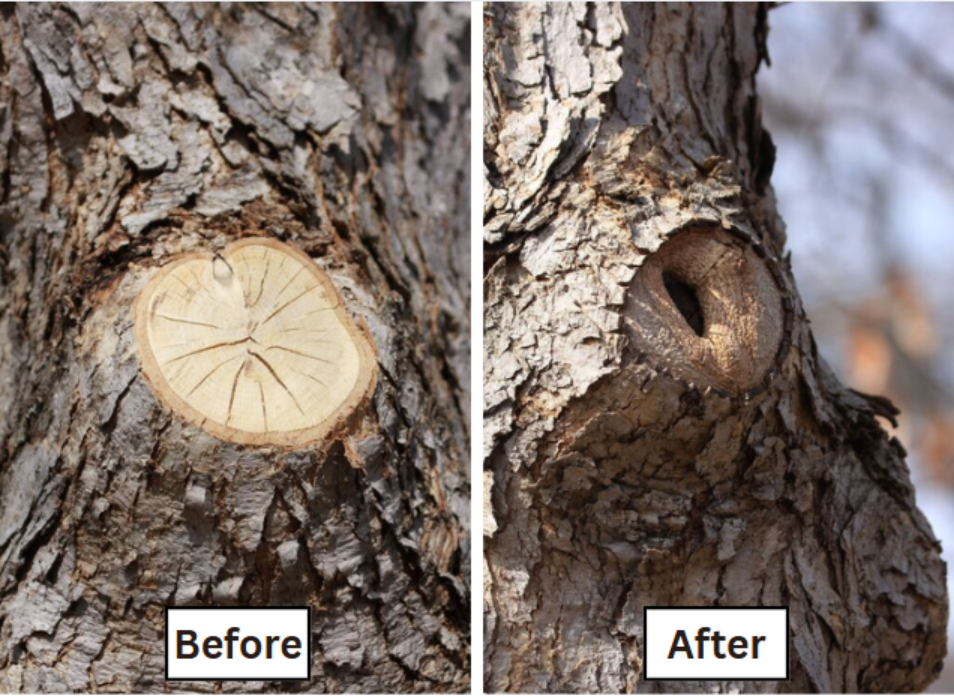
©2016 Steven Katovich
When a clean, small pruning cut is made just outside the branch collar (left), the tree can easily and quickly seal over the pruning cut (right).
Because pruning can have lifelong effects on your tree, ensuring that it’s done properly is critical. Speaking to an International Society of Arboriculture (ISA)-certified arborist with pruning skills and knowledge is a great starting point. You can check out our blog to help you select a qualified tree care company. The ISA Pruning Young Trees and Pruning Mature Trees factsheets are also excellent resources to help guide you through the fundamentals of pruning.
Conclusion:
Trees may not heal like we do, but their ability to survive injury is remarkable. Through CODIT, trees strategically contain and isolate damage, allowing them to continue growing for decades or even centuries after being wounded. Understanding how trees manage damage helps us see why proper care, such as good pruning, is so important – when we work with a tree’s natural defences, we give it the best chance for stability and to thrive long term.
Interested in learning more about tree health? Visit our Tree & Shrub Health & Care page for more information. Looking to prune your LEAF tree? LEAF offers corrective pruning services for young trees (less than 14 feet in height) planted through our Backyard Tree Planting Program. To learn more, visit our Maintenance and Pruning Services page.
Jess Wilkin is an ISA Certified Arborist and the Residential Planting Programs Operations Supervisor at LEAF.
LEAF offers a subsidized Backyard Tree Planting Program for private property. The program is supported by the City of Toronto, the Regional Municipality of York, the City of Markham, the Town of Newmarket, the City of Vaughan, the Regional Municipality of Durham, the Town of Ajax, the Municipality of Clarington, the City of Oshawa, the City of Pickering, the Township of Scugog, the Town of Whitby and Ontario Power Generation.